Bond Duration in 2 Minutes: The Math Every Investor Should Know
Bond prices fall when yields rise — but by how much? A single number, duration, answers that question well enough for every practical decision you will ever make about bonds.
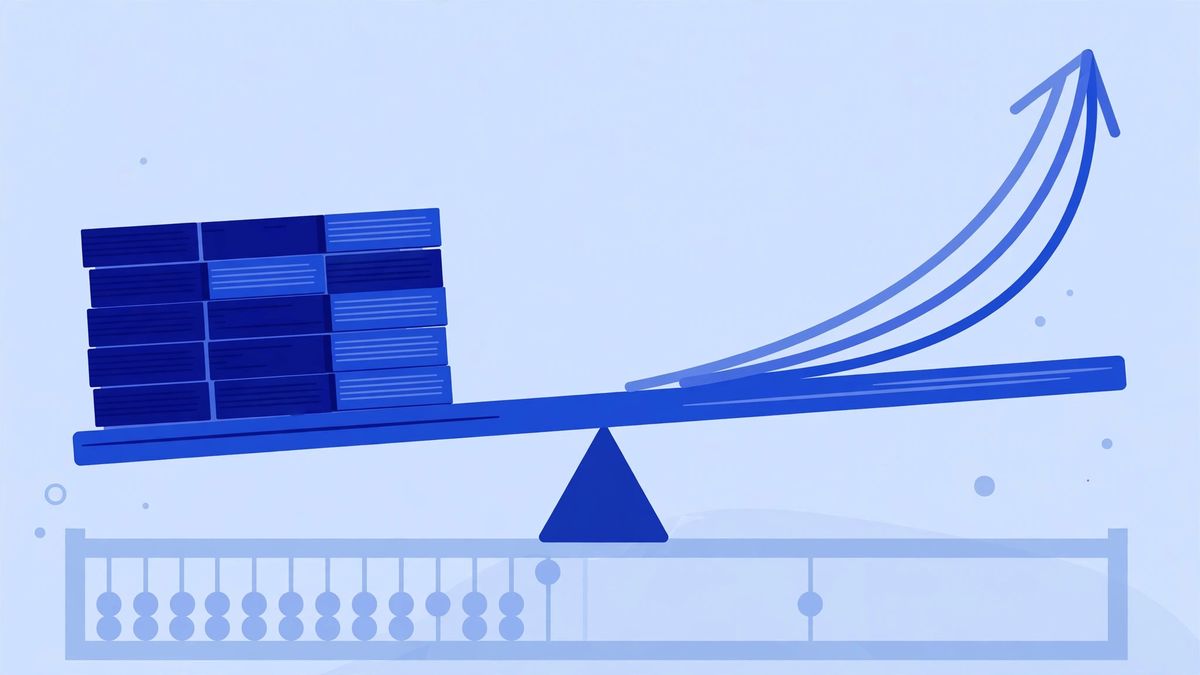
Of all the jargon in fixed income, duration is the one concept that repays two minutes of attention many times over. It is a single number — published for every bond fund, usually right on the fund's overview page — that tells you roughly how much the price will move when interest rates change. Learn the one formula below and you will never again be mystified by a bond fund's bad year.
The one formula
Here it is, the whole thing:
Price change ≈ −duration × change in yield
If a bond fund has a duration of 6 years and yields rise by 1 percentage point, expect the fund's price to fall roughly 6%. If yields fall 1 point instead, expect roughly a 6% gain. The minus sign is the seesaw: yields up, prices down; yields down, prices up. That is genuinely most of what you need. Everything else in this article is color commentary.
A couple of caveats keep the formula honest. It is an approximation — accurate for small yield moves, less so for violent ones. And it describes price movement only; your total return also includes the interest the fund pays you along the way, which softens the blow (more on that below).
What duration actually measures
Despite the name, duration is not simply "how long until the bond matures." It is a weighted average of when you receive the bond's cash flows — part time measure, part sensitivity dial. Two bonds maturing in ten years can have different durations if one pays generous coupons along the way (money back sooner = lower duration) and the other pays nothing until the end (all the waiting = higher duration).
For bond funds, the provider publishes an average duration for the whole portfolio. A short-term bond fund might show a duration of 2–3 years; an intermediate fund 5–7; a long-term fund 12 or more. Read that number as a sensitivity setting: the higher it is, the more dramatic the fund's reaction to every rate move, in both directions.
Using duration to size your risk
The formula turns into a practical decision tool immediately. Suppose you are choosing between two bond funds and rates might rise 2 percentage points over the next year or two — a large but historically plausible move. Fund A has a duration of 3; Fund B has a duration of 8. Rough math: Fund A loses about 6% of price, Fund B about 16%. If that 16% would ruin your plan, you have your answer — no economics degree required.
This is also why the standard advice for nervous bond investors is to shorten duration, not to abandon bonds. Moving from an intermediate fund (duration ~6) to a short-term fund (duration ~2.5) cuts your rate sensitivity by more than half while keeping you invested. You give up some yield; you buy a lot of sleep.
One more wrinkle worth knowing: a fund's duration drifts over time. As bonds age and the manager trades, the published duration creeps up or down, and a fund that was a "duration 5" when you bought it might read 6.5 two years later. It takes thirty seconds to re-check the fund's overview page once a year — add it to whatever annual review ritual you already have, next to rebalancing and beneficiary checkups. Small drift is normal; a fund that has quietly doubled its duration deserves a second look at whether it still fits the job you hired it for.
The half of the story everyone misses
Here is what the headlines skip when bond funds have a terrible year: rising yields are bad for bond prices but good for bond investors who stick around. Every coupon payment and every maturing bond inside the fund now gets reinvested at the new, higher yield. The higher the yield climbs, the faster this reinvestment engine repairs the damage.
There is even a rough breakeven for it: divide the duration by the yield and you get a back-of-the-envelope estimate of how long until higher reinvestment income offsets the initial price drop. A fund with duration 6 yielding 5% needs roughly a year or so of higher income to climb back — painful in the moment, but a far cry from permanent loss, provided you do not sell at the bottom. This is the mechanical reason patient bond holders have historically recovered from every rate shock: time plus higher yields does the healing.
Three duration habits worth keeping
1. Check duration before you buy any bond fund. It is on the fund's overview page, next to yield and expense ratio. If you cannot find it in ten seconds, that is itself information about the provider.
2. Match duration to your horizon, roughly. Money you need in two years does not belong in a fund with a duration of eight. This is not precision engineering — it is avoiding category errors.
3. When rates rise, do the math before you panic. Multiply the fund's duration by the yield move you are worried about. That number is the approximate price hit — usually much smaller than the fear, and partially offset by the higher income already flowing in.
Duration will not tell you where rates are going — nothing will. But it translates every rate forecast, good or bad, into a concrete number for your fund. In a corner of investing full of vague anxiety, that is about as close to a superpower as it gets.